The Paper Edit: Arrange an Interview Before Touching the Timeline
A paper edit helps shape a short interview before editing begins: group transcript excerpts, test their order and spot gaps without opening the timeline.
A paper edit can reveal the shape of a short interview before you open an editing timeline. With a transcript, scissors or a text document, and a few clear labels, you can group what the speaker actually said, try different sequences and see where the piece needs a bridge.
The point is not to make the final edit on paper. It is to decide what each passage contributes while moving words remains quick and reversible. Here is one invented situation, from raw transcript to a workable editorial map.
What material does the paper edit need?
Imagine that Leila is making a short audio portrait of a neighbour who repairs broken umbrellas at a market stall. She has recorded a relaxed interview and transcribed the portions that seem relevant. The transcript includes a description of the stall, a story about a customer caught in sudden rain, a quiet account of learning the trade from an aunt, and a few practical details about spokes and fabric.
Leila does not begin by copying every line into a preferred order. First she makes a working transcript that preserves the wording, including hesitations when they affect meaning. She marks speaker changes and notes any audible context worth remembering, such as a pause before an answer or the rattle of rain on the stall roof. Those notes are reminders for later listening, not substitutes for the recording.
She then breaks the transcript into excerpts. Each excerpt should carry one thought or moment that can be considered on its own. A long answer may become several cards if it moves from a memory to an explanation; a short exchange may stay together when the question is needed to make the answer intelligible.
- Keep the transcript wording intact; do not silently polish the speaker’s phrasing.
- Give each excerpt a short identifying label, such as “first repair” or “aunt’s lesson”.
- Record a transcript page, paragraph or time reference beside each passage.
- Mark questions or prompts that are needed to understand the response.
- Set aside uncertain passages for a fresh listen rather than guessing at their meaning.
If Leila is working on paper, she prints the selected transcript and cuts between excerpts. If she is working on a laptop, she copies each passage into a separate block in a document. Either way, she keeps an untouched master transcript and uses a duplicate for rearranging. The master is the source; the movable excerpts are the editing surface.
How can excerpts be grouped without forcing a story?
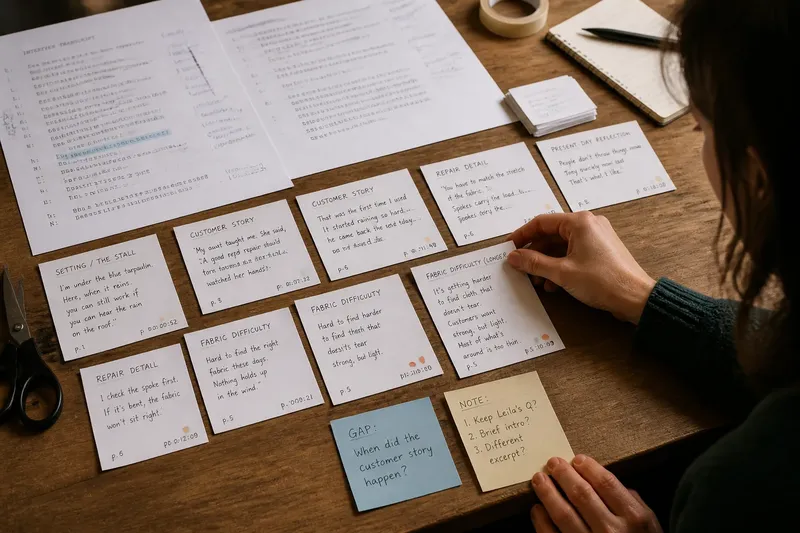
Leila starts by sorting excerpts according to what they do, not where they occurred in the conversation. She makes loose groups for setting, an early memory, the repair process, a turning point, and what the work means to the speaker now. These are provisional piles, not sections the finished piece must keep.
This distinction matters. An interview’s recording order often reflects the interviewer’s route through a conversation: a warm-up question, a follow-up, a detour, then a return to the original subject. The paper edit lets Leila consider a different order, but it cannot make a passage say something its speaker did not say. Group by meaning, then listen for the limits of each excerpt.
She notices that two passages both describe how difficult it is to find suitable umbrella fabric. One gives a specific detail; the other repeats the same point at greater length. She puts them beside each other and marks the second as a possible reserve, rather than deleting it. That choice reduces repetition in the working arrangement while preserving the option to restore the fuller explanation.
For a clear overview, Leila puts one excerpt on each card and writes its function in a few words: “place”, “first lesson”, “customer story”, “repair detail”, or “present-day reflection”. The labels describe what a listener might receive from the passage, not an interpretation of the speaker’s character. A card that has no clear function is not automatically useless; it is a prompt to ask what would be lost if it were left out.
Think of the cards as recipe ingredients laid out on a kitchen table. They can be moved into a useful order, but rearranging them does not create an ingredient that was never there. If the interview lacks an answer that the piece needs, the paper edit should make that absence visible rather than disguise it.
What order makes this interview understandable?
Leila tries three openings. The stall description gives a strong sense of place but delays the human connection. The umbrella repair story has an immediate event, but its first line refers to a detail not yet introduced. The account of her aunt teaching her to mend a torn canopy offers a person, an action and a reason to keep listening.
She places the aunt excerpt first, then the customer story, then the practical explanation of how a repair is judged. To close, she tries the present-day reflection. This is not a claim that the events happened in that order. It is an editorial sequence built from the interview’s existing material, and the transitions must make that arrangement clear without implying a false chronology.
Say Leila finds that the customer story begins, “That was the first time I used her trick.” On its own, the line leaves “her” and “the trick” unclear. She moves the aunt excerpt immediately before it and listens to both passages in sequence. The expected observable result is that the reference has an audible antecedent; if the relationship still feels obscure, she can restore a needed question or choose another opening.
As she tests the order, she writes a one-line note between cards wherever a listener may need context: who is speaking, what “that” refers to, or why the next passage follows. These notes are not narration to add automatically. They identify a choice: retain the interviewer’s question, use a brief introduction, find a more self-contained excerpt, or leave the connection out.
What should the paper edit reveal about gaps and cuts?
When the cards seem to form a sequence, Leila reads the excerpts aloud in that order. She does not smooth away every pause or awkward phrase. Instead, she listens for the larger joins: a sudden change in subject, a pronoun without a clear referent, an answer that depends on an omitted question, or a jump that could make separate moments sound simultaneous.
One gap appears between the aunt’s lesson and the customer story. The interview explains how the speaker learned a repair technique, but not whether the customer story happened during an early year or much later. Leila cannot settle that from the excerpt cards. She marks the join for checking against the recording and avoids placing language around it that would assert a date or cause.
The paper edit also exposes passages that are emotionally or tonally mismatched. A lively account of a repair could sit beside a restrained reflection, but the contrast may feel abrupt if no shared idea connects them. Leila tries placing the practical explanation between those passages. It supplies a subject link—careful work—without inventing a dramatic transition.
In the margins, she distinguishes three kinds of mark:
- Keep: the excerpt serves the piece and is understandable in this position.
- Check: replay the source to verify wording, context, tone or a possible edit point.
- Reserve: the passage may help if the piece needs a missing explanation or a different balance.
This is more useful than labelling passages “good” and “bad”. An excerpt can be beautifully spoken but irrelevant to the developing structure; another can sound plain on the page yet become vivid through timing, breath or the room’s natural sound. The paper edit decides what deserves attention in the recording, not what the finished piece must contain.
How do you turn the paper sequence into an editing map?
Once Leila has a sequence she can explain, she makes a clean copy of the arrangement. Each excerpt receives its label, its exact transcript text, and a source reference. She adds brief notes at the joins: “question needed?”, “check who ‘she’ means”, or “listen for a clean pause”. She leaves out speculative narration and any factual detail not supported by the recording.
That map gives her a focused first pass in the audio editor. She can locate the chosen passages, listen to the full answers around them, and mark possible in and out points. The timeline still has work to do: natural pauses, breaths, room tone and the speaker’s emphasis may change how much of a passage belongs in the cut. The paper version simply narrows the search.
Leila’s result is a short sequence that begins with a learned skill, moves to a customer encounter, explains the repair behind it and ends with the speaker’s present view of the work. She also has a reserve excerpt and two joins to verify. That is a useful outcome before editing: not a locked script, but a structure with its open questions clearly marked.
What do people often ask about a paper edit?
How long should a transcript excerpt be?
Use the shortest passage that carries one complete thought, while retaining enough surrounding words to preserve its meaning and voice. If an excerpt needs a question or the end of a previous answer, keep that context attached or mark the dependency clearly.
Can I rearrange an interview into a different chronology?
You can change the presentation order when each passage remains truthful in its new position. Check time references and transitions carefully, and do not use a sequence or added narration that suggests events occurred together or in a different order.
Should the paper edit include the interviewer’s questions?
Keep a question when it supplies context, makes the answer intelligible or contributes to the exchange. If the answer stands alone, you can mark the question as optional and decide after listening to the recorded pacing.
Can I make a paper edit without a printed transcript?
Yes. Separate text blocks in a document can be rearranged, and a handwritten list of excerpts can work if each entry points back to its source. The important part is keeping the original transcript unchanged and making every moved passage easy to find again.
What makes the paper edit useful after the first arrangement?
Leila saves both the first arrangement and the revised one, with a short note on why she moved the customer story. If a later cut feels confusing, she can compare the sequence against the original logic instead of trying random changes on the timeline. The notes also distinguish an intentional omission from a forgotten passage.
For your own paper edit, treat every rearrangement as a question to check against the recording: does this excerpt still mean what it meant in context, and can a listener follow the join? That keeps the paper sequence honest while making it easier to see the interview’s shape before the timeline starts to fill.